
If your Kawasaki hydraulic pump starts showing unusual noise, loss of power, or overheating, it’s a clear signal something is wrong Hydraulic power is the muscle behind every smooth movement on an excavator.
When the pump starts to slip, the whole machine tells you quietly at first, then loudly. Spotting those signals early is the difference between a quick service visit and a full tear-down.
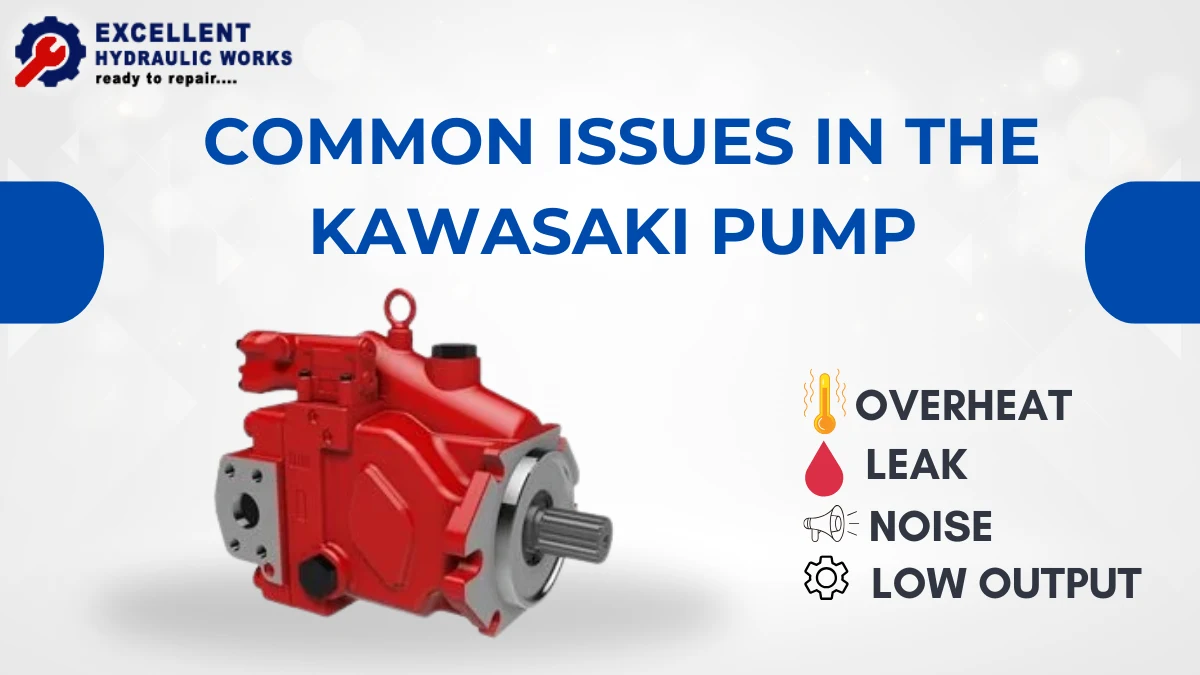
Below are the Common Issues in Kawasaki Pump technicians look for in the field-
1) Loss of Force and Slower Cycles
If it takes longer to time to start if the bucket won’t hold a load, the pump is no longer delivering rated flow and pressure. Operators usually describe it as the machine “feeling tired.”
Check it in a simple ways: warm the machine, confirm engine RPM, verify pilot pressures, and look for external leaks that steal pressure. When those pass, we move to pump efficiency tests Kawasaki hydraulic pump parts which include pistons, valve plates, and bearings followed by calibration on a test stand.
2) New noises: Whining, Rattling, or a Dry Bearing Sound
A healthy pump hums. A high-pitched whine, a gravelly rattle, or a dry bearing note points to cavitation or aeration air at the inlet, clogged strainers, or oil that’s too thin for the ambient temperature. Left alone, those bubbles implode and pit metal surfaces.
During hydraulic pump troubleshooting, we check suction restrictions, case-drain flow, and filter collapse indicators. If damage is visible.
3) Overheating Hydraulic Oil
Hot oil thins, loses lubrication, and accelerates wear. When tank temperature climbs, we look for internal leakage inside the pump, incorrect relief settings, or restricted coolers. Thermal issues usually travel with efficiency loss: the pump is doing the same work but wasting energy as heat. Rebuilding the rotating group and setting clearances during Kawasaki K3V pump repair or Kawasaki K5V pump repair restores volumetric efficiency and brings temperatures back within spec.
4) Low Pressure on the Gauges
Pressure tests tell the truth. If the main relief is set correctly but pressure still won’t reach spec under load, the pump is bypassing internally. We confirm with a case-drain test: rising case flow at a fixed pressure equals worn components. At this stage, replacing worn Kawasaki hydraulic pump parts is more than a performance fix—it protects valves and travel motors downstream from debris and starvation.
5) Jerky, Uneven, or Drifting Movements
Smooth motion requires stable flow. Jerks, hesitations, or cylinders drifting down under load point to trapped air, suction leaks, sticky control elements, or internal wear. We inspect every low-pressure joint on the suction side, verify pilot pressure and servo control response, and check the compensator. If mechanical wear is confirmed, Kawasaki pump reconditioning brings the swash mechanism, servo pistons, and bearings back to spec so modulation becomes precise again.
6) Visible Leaks or Contaminated Oil
A dry pump is a happy pump. Wet cases, oily dust, foaming in the tank, or metallic glitter in filters are bright red flags. Contamination shortens life dramatically; it turns every moving surface into a lapping plate. Proper hydraulic pump maintenance means fixing the leak, flushing circuits, replacing filters, bleeding air, and installing the right hydraulic pump spare parts before restart. Skipping the cleaning step ruins a fresh rebuild in hours.
7) Higher Fuel Use for the Same Work
Engines burn more diesel when the pump wastes energy internally. If production falls while fuel bills climb, suspect a slipping pump, not the engine. Bringing clearances back within tolerance through Kawasaki axial piston pump repair often restores fuel efficiency and pays for itself quickly.
Read This: How to Identify Signs about hydraulic pump need repair
How Technicians Confirm the Diagnosis
Good decisions come from good tests. Our routine sequence is simple and repeatable:
- Warm-up & visual: look for leaks, loose suction clamps, collapsed hoses, clogged breathers.
- Suction vacuum check: excessive inlet vacuum = restriction → cavitation risk.
- Pressure & flow under load: compare readings to spec at operating temperature.
- Case-drain measurement: elevated flow at given pressure = internal leakage.
- Control response: verify pilot pressure, compensator function, and swash-plate movement.
When a rebuild is the smart path, we use genuine Kawasaki hydraulic pump parts, document clearances, lap mating surfaces, and calibrate compensator and swash angles on a bench before the pump returns to your machine.
Maintenance that Prevents Most Failures
Most painful repairs are preventable. Use oil that meets the OEM spec, change filters on schedule, keep breathers clean, sample oil seasonally, and watch cooler performance. That is the core of hydraulic pump maintenance. A few minutes with a handheld temperature gun and a pressure gauge during weekly checks will catch small drifts long before they become expensive downtime. In dust, water, or high-heat environments, tighten those intervals—environment beats components every time.
The Bottom Line
A failing pump never arrives without notice. It whispers through slower cycles, strange sounds, rising temperatures, soft pressures, jerky motion, and dirty oil. Listen early, test properly, and act decisively. With disciplined hydraulic pump troubleshooting and timely reconditioning, you can protect your machinery in defined schedule and your budget. Whether that’s Kawasaki K3V pump repair or Kawasaki K5V pump repair, choose quality spare parts as per OEM standards, so the fix lasts, not just for today, but for the next thousands of operating hours.